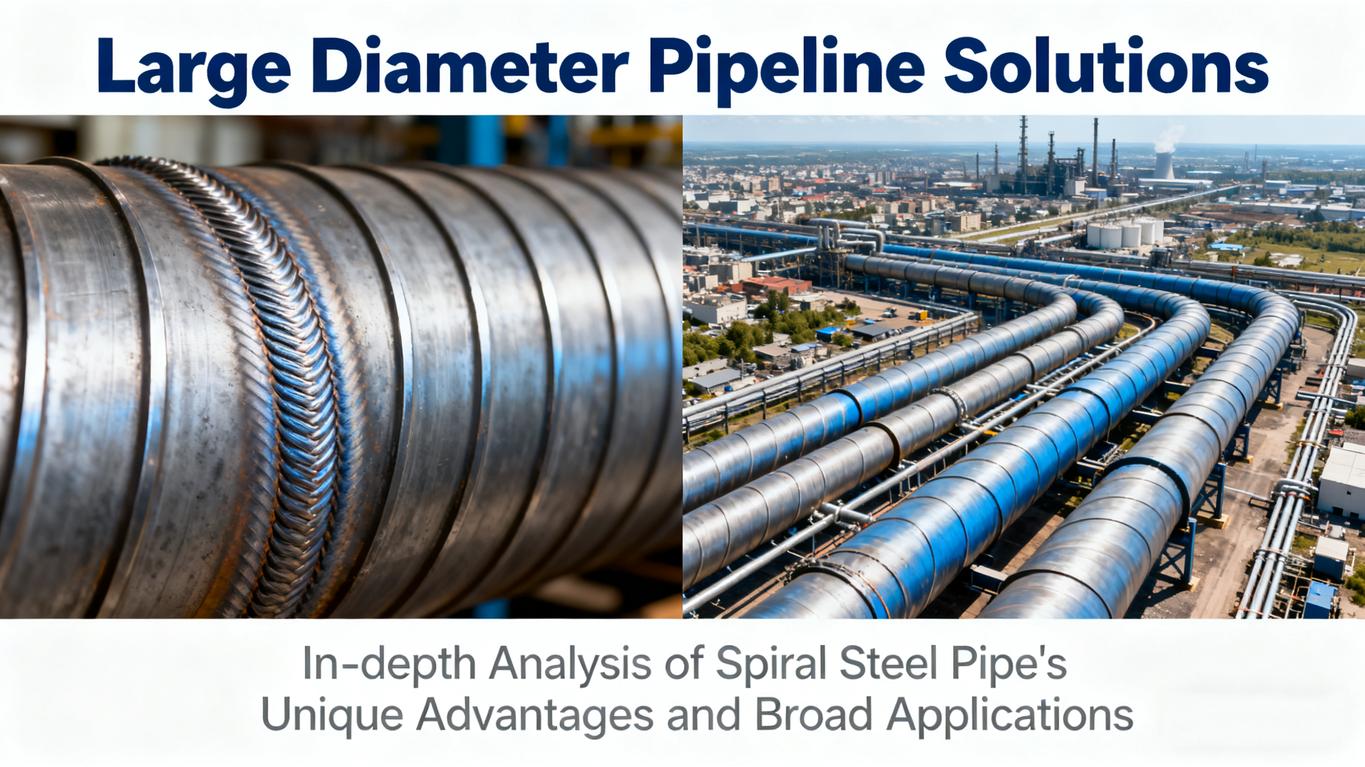
Large Diameter Pipeline Solutions: In-depth Analysis of Spiral Steel Pipe's Unique Advantages and Broad Applications
Introduction
-
Highlight the pivotal role of large-scale transmission pipelines (e.g., oil, gas, water) in infrastructure development.
-
Point out that these projects demand extreme requirements for pipe diameter, length, strength, and cost-effectiveness, where traditional straight seam welded pipes or seamless pipes might have limitations.
-
Introduce Spiral Steel Pipe, often referred to as Spiral Submerged Arc Welded Pipe (SSAW/HSAW Pipe), as an ideal large-diameter pipeline solution.
-
State that this article will thoroughly explore the unique manufacturing process, core advantages, wide-ranging applications, and selection considerations for spiral steel pipe.
Part 1: What is Spiral Steel Pipe (Spiral Steel Pipe / SSAW Pipe)?
-
Definition: Explain that Spiral Steel Pipe is formed by spirally rolling steel strip or coil into a pipe shape, then welded using the Submerged Arc Welding process.
-
"Spiral" Process Characteristics:
-
Steel strip/coil is continuously rolled at a specific angle.
-
The weld seam runs in a spiral direction, forming an angle with the pipe's axis.
-
-
"Submerged Arc Welding" Process:
-
Briefly describe the principle of submerged arc welding: welding wire is fed under a layer of flux, resulting in high-quality welds with deep penetration.
-
Usually involves double-sided (internal and external) submerged arc welding to ensure weld strength and sealing integrity.
-
-
Overview of Advantages: Allows for the production of large diameter pipes, long fixed lengths, high strength, and cost-effectiveness.
Part 2: Core Advantages of Spiral Steel Pipe (Spiral Steel Pipe)
-
Large Diameter and Long Fixed Lengths:
-
Keywords: large diameter steel pipe, long length
-
Enables the production of large-diameter pipes from narrower steel strips, overcoming width limitations of rolling mills.
-
Achieves longer single pipe sections, reducing on-site welds and improving construction efficiency.
-
-
High Strength and Excellent Mechanical Properties:
-
The unique stress distribution of the spiral weld often gives spiral steel pipe superior resistance to bending, compression, and torsion.
-
Keywords: high strength, good mechanical properties
-
The submerged arc welding process ensures weld quality close to the parent material, providing excellent sealing (Good Sealing).
-
-
High Cost-Effectiveness:
-
Production costs are relatively lower, especially for large-diameter and long-distance transmission projects.
-
High material utilization efficiency.
-
-
Strong Dimensional Adjustability:
-
By adjusting the forming angle, different pipe diameters can be produced from the same width of steel strip, offering high production flexibility.
-
-
Uniform Wall Thickness:
-
Despite being a welded pipe, controlled manufacturing processes can achieve relatively uniform wall thickness.
-
Part 3: Wide-Ranging Applications of Spiral Steel Pipe (Spiral Steel Pipe)
-
Oil & Gas Transmission Pipelines:
-
Keywords: oil and gas pipeline, natural gas transmission
-
Long-distance onshore and offshore oil and gas transportation; API 5L standard spiral pipes are widely used.
-
-
Water Conservancy Projects:
-
Keywords: water transmission pipe, water supply projects
-
Large-diameter water supply pipelines, tap water, and drainage systems.
-
-
Piling and Structural Engineering:
-
Keywords: piling pipe, structural pipe
-
Building foundations, bridge foundations, port and dock pilings, offshore wind power foundations.
-
Used as structural support pipes, such as culverts and trusses.
-
-
Dredging and Marine Engineering:
-
Keywords: dredging pipe, marine engineering
-
Transportation of dredging mud and sand, construction of marine platforms.
-
-
Heating and Power:
-
Centralized heating, ash transportation in thermal power plants, circulating water pipelines.
-
Part 4: Quality Control and Selection Advice for Spiral Steel Pipe
-
Standard Basis: Introduce commonly used international standards such as API 5L, ASTM A252, EN 10217, GB/T9711 (adjust based on your actual products and markets).
-
Steel Grade: Select the appropriate steel grade based on project pressure, temperature, and environmental conditions.
-
Inspection Requirements: Emphasize the importance of non-destructive testing for welds (e.g., ultrasonic testing, radiographic inspection).
-
Supplier Selection: Choose manufacturers with advanced production equipment, a comprehensive quality management system, and a good reputation.
Conclusion
-
Summarize that Spiral Steel Pipe (Spiral Steel Pipe), with its unique manufacturing process, demonstrates outstanding high strength, cost-effectiveness, and flexibility in large-diameter, long-distance transmission pipelines and various engineering projects.
-
Emphasize that whether for oil & gas pipelines, water transmission pipes, or piling & structural pipes, spiral steel pipe provides a reliable and cost-effective solution.
-
Urge purchasers and engineers to fully consider the advantages of spiral steel pipe when selecting pipe materials to meet complex and varied project demands.
-
CTA (Call to Action): Contact us for customized spiral steel pipe products and expert engineering application advice!
A106 vs. API 5L: Why Choosing the Wrong Grade B Material Could Risk Your High-Pressure System.
How to Properly Store and Protect Steel Pipes