Third-Party Inspection for Steel Pipes: Ensuring Quality, Compliance, and Buyer Confidence
In today’s competitive global steel market, third-party inspection (TPI) has become a crucial step in international trade. Whether you are purchasing ERW pipes, seamless pipes, SSAW/LSAW welded pipes, or industrial flanges, independent inspection ensures that every shipment meets the required standards, dimensions, and quality expectations.
For importers and EPC contractors, working with a supplier who welcomes third-party inspection is a sign of credibility, transparency, and long-term reliability. This article explains why TPI is important, how it is conducted, and what you should look for in an inspection report.
1. Why Third-Party Inspection Is Essential
Steel pipes are used in critical applications — from oil & gas pipelines to structural and mechanical systems — where even a minor defect can lead to serious consequences.
Third-party inspection acts as an objective quality control system, protecting buyers against potential risks.
1.1 Quality Assurance Beyond Factory Claims
While most manufacturers provide internal quality reports, a third-party agency provides independent verification of material, production, and testing results.
This helps avoid:
-
Material substitution
-
Inconsistent wall thickness
-
Defective welds
-
Improper marking or packaging
1.2 Compliance with International Standards
TPI agencies verify compliance with international specifications such as:
-
API 5L / API 5CT (Oil & Gas pipes)
-
ASTM A106 / A53 / A312 (Carbon & stainless steel pipes)
-
EN 10219 / EN 10210 (Structural hollow sections)
-
ISO 9001, ISO 3183, ASME, DIN standards
This ensures that products are not only made correctly but are also certified correctly for export and project documentation.
2. Who Performs Third-Party Inspections
There are several global inspection organizations authorized to conduct steel pipe inspections. Commonly recognized names include:
-
SGS (Société Générale de Surveillance)
-
BV (Bureau Veritas)
-
TÜV Rheinland / TÜV SÜD / TÜV Nord
-
Intertek
-
DNV / Moody / Lloyd’s Register
These agencies are neutral, accredited, and operate under ISO standards to provide impartial inspection and certification services.
Hebei Cangtie Industrial Co., Ltd frequently cooperates with these agencies for on-site inspection at our factory and shipping port.
3. The Main Stages of Third-Party Inspection
A complete third-party inspection process for steel pipes usually includes several stages, from raw material to final shipment.
3.1 Pre-Production Inspection (PPI)
Before production starts, the inspector verifies:
-
The source and certificate of the raw materials (hot-rolled coil or billet).
-
The dimensions, grades, and technical requirements of the order.
-
Calibration of measuring instruments and welding machines.
3.2 In-Process Inspection
During production, inspectors monitor:
-
Welding process for ERW or spiral welded pipes.
-
Dimensional accuracy (OD, thickness, ovality).
-
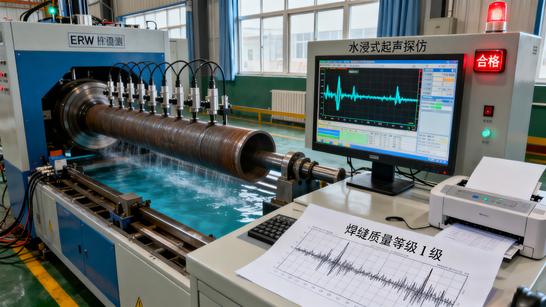
Non-destructive testing (NDT) — ultrasonic or eddy current tests.
-
Hydrostatic testing for pressure resistance.
This stage ensures that quality is maintained continuously rather than only at the end.
3.3 Final Inspection (Pre-Shipment Inspection)
Before shipment, the inspection covers:
-
Visual inspection of surface finish and coating.
-
Dimensional verification and length measurement.
-
Checking marking, labeling, and packaging.
-
Random sampling for chemical composition or mechanical test review.
-
Verification of document completeness (MTC, test certificates, packing list).
Inspectors issue a Final Inspection Report (FIR) and often seal the inspected bundles for shipment.
4. Key Inspection Tests for Steel Pipes
Third-party agencies perform or verify several tests depending on the pipe type and standard:
| Test Type | Purpose | Typical Standard |
|---|---|---|
| Visual Inspection | Detect surface defects | API 5L / ASTM |
| Dimensional Check | Verify OD, thickness, length | API / EN |
| Hydrostatic Test | Pressure integrity | ASTM / API |
| Ultrasonic / Eddy Current Test | Detect weld or wall defects | EN 10246 |
| Flattening / Bending Test | Check ductility | ASTM A53 / A106 |
| Chemical & Mechanical Test Review | Verify MTC data | ISO 3183 |
| Coating & Zinc Test | Check coating thickness | ISO 1461 |
Buyers can request full or partial inspection according to contract terms.
5. Typical Inspection Documentation
After inspection, the agency provides a set of reports and certificates, usually including:
-
Inspection Report / Release Note
-
Mill Test Certificate (EN 10204 3.1 or 3.2)
-
Dimensional and Visual Inspection Sheet
-
Test Result Summary
-
Photographic Evidence
The EN 10204 3.2 certificate (signed by a third-party inspector) is the highest assurance level for buyers, confirming that the product has passed independent verification.
6. Buyer’s Role in the TPI Process
Buyers can specify their inspection requirements directly in the purchase contract or technical specification:
-
Select an approved inspection agency (e.g., SGS).
-
Define inspection scope (dimensional check, coating test, etc.).
-
Require advance notice before inspection (usually 3–5 days).
-
Ask for photo or video evidence if on-site inspection is not possible.
By maintaining communication with both supplier and inspection agency, buyers can ensure transparency and avoid misunderstandings.
7. Hebei Cangtie’s Commitment to Quality and Transparency
At Hebei Cangtie Industrial Co., Ltd, we understand that overseas buyers need trust, documentation, and accountability.
We fully support any third-party inspection requested by clients and provide:
-
Complete production traceability with heat number and batch control.
-
Full access for SGS, BV, or TUV inspectors at any stage.
-
Free pre-inspection photos and dimension reports.
-
Re-inspection guarantee if any non-conformance is found.
Our policy is simple: quality must be verifiable, not just promised.
8. Case Example: Third-Party Inspection in Practice
A European client ordered API 5L X52 ERW pipes for a gas distribution project. Before shipment, BV conducted an independent inspection at our plant:
-
Verified dimensions and welding quality.
-
Checked hydrostatic test results for each batch.
-
Measured coating thickness and verified marking accuracy.
-
Witnessed loading and sealing of containers.
All items passed inspection, and BV issued a 3.2 certificate confirming compliance. The client later expanded cooperation to include seamless pipes and flanges — a direct result of transparent quality control.
9. Benefits of Third-Party Inspection
-
✅ Protects buyer’s investment and reputation
-
✅ Ensures compliance with technical standards
-
✅ Enhances supplier accountability
-
✅ Reduces project risks and disputes
-
✅ Builds long-term trust between buyer and manufacturer
10. Conclusion
Third-party inspection is not an obstacle — it’s a bridge of trust between buyer and supplier.
By allowing recognized agencies like SGS, BV, or TUV to independently verify product quality, both sides benefit from transparency, efficiency, and peace of mind.
At Hebei Cangtie, we believe that quality control is a shared responsibility — from the steel mill to the project site.
Through third-party inspection, we ensure that every steel pipe delivered to our global clients meets the highest international standards.
“Inspection builds confidence, and confidence builds partnerships.”
Samples and After-Sales Service: Building Trust and Long-Term Cooperation in the Steel Pipe Industry