Applications of Spiral Welded Steel Pipes (SSAW): Uses, Advantages, and Limitations

1. Overview
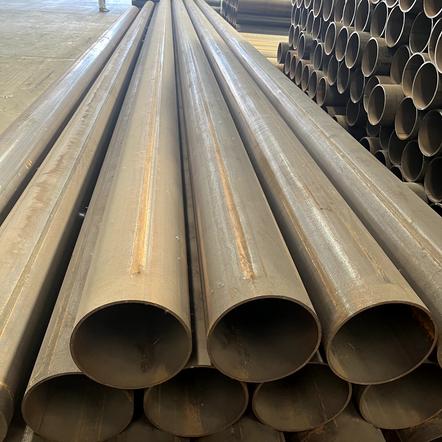
Spiral Submerged Arc Welded (SSAW) steel pipes, also known as helical welded pipes, are manufactured by spirally bending a steel coil into a cylindrical shape and welding the seam continuously on both sides using submerged arc welding technology.
Their spiral weld geometry allows for the production of large-diameter pipes with excellent strength and flexibility, making them a key material for long-distance fluid transportation and large-scale infrastructure projects.
2. Major Applications
(1) Oil and Gas Transportation
SSAW pipes are widely used in long-distance oil and gas transmission pipelines, especially where high pressure and large diameters are required.
Applications include:
-
Crude oil and natural gas mainlines
-
Offshore pipeline systems
-
Gathering and distribution networks
Why: The spiral structure provides uniform stress distribution and superior resistance to external pressure.
Benefit: High weld strength, good toughness, and economic advantage for long pipelines.
(2) Water Supply and Drainage Projects
SSAW pipes are essential in municipal and industrial water transportation, as well as irrigation and drainage systems.
Applications include:
-
City water supply pipelines
-
Drainage and flood control systems
-
Large-scale irrigation networks
Why: Available in diameters up to 100 inches, SSAW pipes are ideal for handling large water volumes.
Benefit: Lower installation costs compared to seamless or ERW pipes of similar diameter.
(3) Structural and Piling Use
Due to their excellent weld performance and diameter flexibility, spiral pipes are extensively used for structural supports and piling foundations.
Applications include:
-
Offshore platform piles
-
Bridge piers and foundation columns
-
Port construction and coastal protection projects
Why: Their high compressive strength and weld continuity ensure safety and stability.
Benefit: Cost-effective for deep foundation and heavy load-bearing structures.
(4) Industrial and Energy Projects
SSAW pipes are used in energy transportation, hydropower plants, and industrial pipelines for air, steam, or other non-corrosive fluids.
Why: Customizable thickness and coatings make them adaptable to diverse working conditions.
Benefit: Long service life, especially when combined with internal and external anti-corrosion layers (3PE, FBE, epoxy).
3. Advantages of SSAW Steel Pipes
| Category | Advantage | Explanation |
|---|---|---|
| Large Diameter Capability | Up to 2500mm or more | Suitable for bulk fluid transportation |
| High Strength and Stability | Spiral weld evenly distributes stress | Performs well under internal and external pressure |
| Flexible Production | Can use narrow steel strips to produce wide pipes | Reduces material costs |
| Efficient Welding | Continuous automatic submerged arc process | Ensures consistent weld quality |
| Economic Efficiency | Lower cost per unit length than seamless pipes | Ideal for long-distance, large-diameter projects |
4. Limitations of SSAW Steel Pipes
| Aspect | Limitation | Impact |
|---|---|---|
| Weld Seam Angle | Spiral seam increases length of weld | Slightly higher chance of weld defect if not properly inspected |
| Not Ideal for High Pressure | Lower burst strength than seamless pipes | Used mainly in low- to medium-pressure systems |
| Corrosion Protection Needed | Large surface area requires coating | Increases maintenance cost if unprotected |
| Less Suitable for Small Diameters | Not economical for <300mm size | ERW or seamless pipes are more cost-effective |
5. Recommended Application Scenarios
| Industry | Recommended Use | Reason |
|---|---|---|
| Oil & Gas Transmission | Long-distance pipelines | Large diameter, high productivity |
| Water Supply | Municipal and irrigation projects | Handles large flow efficiently |
| Construction | Foundation and piling pipes | Excellent compressive strength |
| Energy & Hydropower | Cooling and drainage systems | Durable and corrosion-resistant |
| Port Engineering | Offshore piling and coastal barriers | Strong weld performance under marine conditions |
6. Summary
Spiral welded (SSAW) steel pipes combine large-diameter capability, reliable weld integrity, and economic manufacturing, making them the preferred choice for oil, gas, water, and structural projects on a large scale.
Though not suitable for ultra-high-pressure environments, their cost efficiency and flexibility make them one of the most commonly used welded pipe types in infrastructure and energy transportation systems worldwide.
Applications of ERW Steel Pipes: Uses, Advantages, and Limitations