Seamless, ERW, LSAW: The Ultimate Comparison Guide to Carbon Steel Pipe Types
I. Introduction: The Foundation of Industrial Piping
The global market for carbon steel pipe is vast, powering everything from refineries to municipal water systems. For professionals in industrial piping, choosing the correct pipe manufacturing method—Seamless, ERW (Electric Resistance Welded), or LSAW (Longitudinal Submerged Arc Welded)—is critical to project safety and cost-efficiency. This comprehensive guide details the technical nuances of these three main types of steel pipe.
II. Type 1: The Integrity of Seamless Carbon Steel Pipe
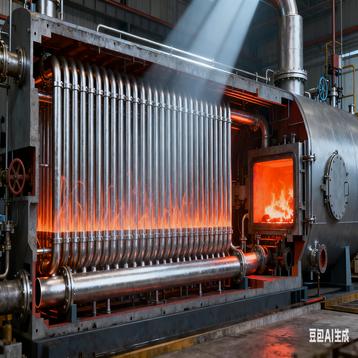
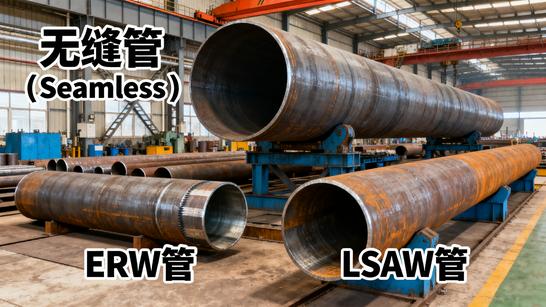
Seamless carbon steel pipe is the gold standard for high-pressure, high-temperature applications. Manufactured by piercing a solid billet, it possesses no weld seam, eliminating the weakest point of a pipe.
-
Key Advantage: Unmatched uniformity and structural integrity, making it resistant to pressure spikes and stress fatigue.
-
Ideal Use: High-pressure boilers, oil and gas drilling, and chemical processing. Many seamless pipes adhere to standards like ASTM A53 Gr.B pipe for general service.
III. Type 2: The Efficiency of ERW Steel Pipe
ERW steel pipe is a cost-effective solution widely used for medium and low-pressure applications. It is made by rolling flat steel into a cylinder and welding the longitudinal seam using high-frequency current.
-
Key Advantage: Excellent outer surface finish, tighter dimensional tolerances, and high production speed.
-
Ideal Use: General service lines like municipal water pipe, low-pressure gas pipe, and structural support.
IV. Type 3: The Strength of LSAW Pipe
LSAW pipe is the powerhouse of the welded pipe family. It is fabricated from thick steel plates, formed into a cylinder, and welded internally and externally using a submerged arc process.
-
Key Advantage: Capable of much larger diameters and thicker walls than ERW, offering superior strength for extreme environments.
-
Ideal Use: Long-distance transmission lines (oil and gas), especially those requiring high-grade specifications like API 5L pipe (Grade X60 and above).
V. Comprehensive Comparison: Performance and Cost Summary
| Feature | Seamless Pipe | ERW Steel Pipe | LSAW Pipe |
| Max Diameter | Medium (< 24 in) | Medium (< 24 in) | Large (> 24 in) |
| Weld | None | Longitudinal (Straight Seam) | Longitudinal or Spiral (Submerged Arc) |
| Pressure Rating | Highest | Medium | High |
| Cost | High | Lowest | Medium-High |
| Best for | Critical High-Pressure | General Utility, Water Pipe | Large Volume Transmission, API 5L pipe |
VI. Selection Guide: Matching Pipe to Application (H2)
The correct selection depends on prioritizing safety, cost, and lifespan:
-
Safety First: If your system involves extremely high pressure or volatile media, prioritize seamless carbon steel pipe.
-
Budget Control: For non-critical gas pipe or water pipe lines, ERW steel pipe provides the best cost efficiency.
-
Large Scale: For major pipeline projects, the strength and scale of LSAW pipe are mandatory.
We supply all three major pipe types, including certified seamless carbon steel pipe and high-grade API 5L pipe solutions, ensuring you receive the perfect steel pipe for your specific needs.
Contact us today for a quote on your next industrial piping project.
Industry Guide: The Critical Role of Seamless Pipes in Boilers – Taking Fire Tube Boilers as an Example